
Wholesale Toy Assortment Planning for Resellers
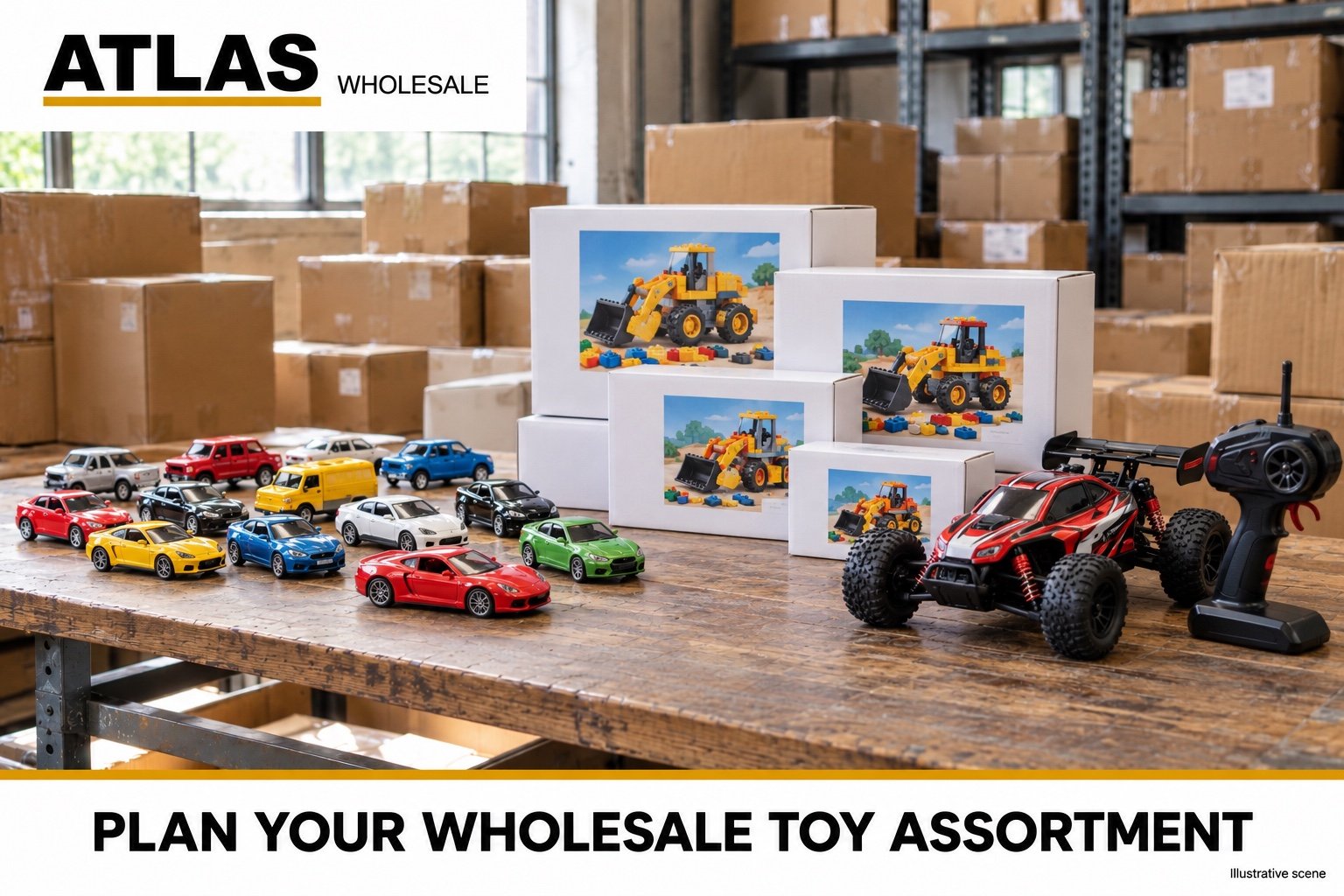
Plan a wholesale toy assortment around the customers you serve, the exact selling units and the time needed to prepare each product type. A large count of loose cars, a small batch of boxed construction sets and an RC assortment create different workloads. Compare them as distinct offers rather than assuming the biggest piece count is the best purchase.
This guide helps US retailers and resellers choose a manageable toy mix. It builds on the toy manifest guide and toy receiving checklist. The focus is assortment and workload planning, with product safety and documentation treated as necessary checks rather than promotional benefits.
Define the store or channel you are buying for
Start with the people who already shop with you or the audience you can reasonably reach. A shop selling low-priced small toys may need a different assortment from a business offering individually photographed boxed products online. Record the expected customer, buying format and available display space.
Do not assign age suitability based on appearance or price. Use reliable manufacturer information and applicable product requirements. A small toy is not automatically suitable for a young child, and an adult collector label should not be invented to avoid an unresolved product question.
For a new selling channel, research comparable products and observe the difference between asking prices and completed sales where available. Record the exact model, packaging and condition used in each comparison. Interest in a general toy category does not establish demand for every variant in a wholesale lot.
Compare units, sets and packs correctly
Create separate columns for individual toys, complete sets and retail packs. A construction set can contain many components but remain one customer sales unit. Counting those components as individual resale opportunities exaggerates the quantity you can offer.
For loose toy cars, establish whether the supplier counts individual vehicles or prepacked groups. For RC products, clarify which accessories form a complete offer. Your worksheet should show what the customer receives, not just the number printed in a promotional headline.
Keep the selling unit consistent when comparing price and labor. A per-car purchase cost and a per-set preparation cost should not be placed in the same column without explanation. Convert each product group into its intended customer offer before calculating the expected workload.
Balance variety against preparation capacity
A broad assortment can create more individual photography and listing work. Repeated units of one confirmed product may be simpler to describe, but they also concentrate the sales plan in that product. Neither variety nor repetition is automatically preferable; the choice depends on your audience and capacity.
Estimate the number of distinct listings, not only total pieces. A 100-unit lot containing 50 unrelated variants may take more catalog work than a 300-unit group with a few clearly identified models. Ask for the model breakdown and treat unknown variation as additional uncertainty.
Choose an initial quantity your team can receive, inspect, organize and list without an indefinite backlog. Stock that remains unopened in a corner has not become a successful sale merely because it was inexpensive to acquire.
Use a practical comparison worksheet
For each lot, record product type, advertised quantity, selling unit, model variation, packaging condition, included accessories and unresolved questions. Add columns for expected preparation tasks and required documentation. Keep supplier statements separate from your own estimates.
A simple planning comparison can be qualitative: low, medium or high handling effort, with a written explanation. For example, counting loose units and making bundles creates different work from photographing carton condition on boxed sets. Do not turn a rough effort label into a precise time promise.
Once you have handled a sample or a first purchase, replace assumptions with actual records where possible. Measure count time, listing time and the number of unresolved items. Keep the original estimate so you can see how the next purchase plan should change.
Keep safety and product records in the decision
The CPSC resale information center explains that US consumer product requirements apply to resellers and highlights the need to examine inventory before resale. Review applicable recall and product documentation questions for the exact goods and your role.
Use the CPSC recall database with identifying details such as model and variant. A broad category search is not enough when similar products differ. No matching recall does not establish full safety or compliance, and a function check is not a safety certification.
If relevant information is missing or a product is damaged, hold it for appropriate review. Do not count questionable stock as ready inventory or mix it into a bargain bundle. Obtain qualified guidance for product-specific safety and regulatory questions rather than relying on a general buying article.
Related Atlas product listings
These are catalog examples checked on October 26, 2026. A published listing does not guarantee current availability, an exact assortment or marketplace eligibility. Confirm the final quotation and product records before ordering.
- Wholesale Lot Of 48 GI Joe Toy Construction Sets – MSRP $9.99 Each – Your Price Is Only $2 Each. A boxed construction-set example: verify set contents, packaging condition and the number of retail offers.
- Wholesale Lot Of 8,000 Pull Back Die-cast 2 3/4″ Toy Cars – Your Price Is Only .34 Each – Free Shipping. A loose-unit comparison: establish the pack format, model mix and counting or bundling workload.
- Wholesale Lot Of 312 RC Toy Cars – MSRPs To $29.99 Each – Your Price Is Only $7.50 Each. An RC assortment comparison: confirm controllers, required power components and model-specific information.
Plan the customer offer before committing to the lot
For individual boxed sales, plan model-level photos, readable identifiers and condition notes. For loose-car packs, define the exact count and permitted variation. Explain duplicates and model selection accurately. Do not show a fixed combination if the customer will receive an unspecified assortment.
For RC products, identify included components and any items required for use. Follow manufacturer instructions for permitted checks and do not improvise battery or electrical repairs. Packaging and accessory differences should be reflected in the customer offer.
Write a draft listing before purchase using only confirmed information. The empty fields will reveal useful supplier questions. If you cannot explain the product, quantity and condition clearly, the purchase needs more investigation before it becomes a public offer.
Calculate scenarios without treating MSRP as revenue
Suppose a hypothetical 60-set purchase costs $180, freight adds $40 and preparation adds $80. The total is $300 before selling fees, customer delivery and overhead. If 50 sets are expected to sell through the chosen channel, the allocated cost is $6 per expected sale. This is a planning example, not an Atlas quote or defect prediction.
Use a second scenario with slower sales, additional preparation and more markdowns. Keep unsold inventory distinct from revenue. An original retail value or an optimistic asking price is not evidence that the stock will sell at that amount.
Separate preparation time by product type. A group of loose cars may require careful counting and pack creation, while an RC assortment may need more accessory and documentation review. A single average can conceal the task that consumes most of your available time.
Buy for the selling calendar you can actually meet
Work backward from the date you need listings ready, including quotation, delivery, receiving, inspection, photographs and publication. Ask for current lead-time information rather than assuming a wholesale order will arrive in time for a planned promotion.
Do not buy a seasonal quantity solely because a calendar event is approaching. Consider what happens if delivery is delayed or demand is lower than expected. A practical fallback route might be ordinary year-round selling, but it needs evidence that the actual products suit that route.
Avoid date-specific promises until the delivery and preparation schedule is supportable. Marketing a product as available for a particular occasion creates an expectation that inventory and dispatch planning must be able to meet.
Review the first purchase before expanding
Track which products were listed, how much preparation they required and what questions customers asked. Separate a slow product from a product that was never properly photographed or published. Use actual sales evidence alongside handling records when deciding whether to buy more.
Keep leftover and held stock visible in the review. A strong sale from one small group can distract from a large unresolved assortment. Measure the whole purchase rather than reporting only the easiest pieces to sell.
Review the agreed claims process and delivery information before the next order. Specific evidence from your first receiving experience can improve questions about packing, model mix and documentation without assuming a future shipment will be identical.
Frequently asked questions
Is the largest toy lot always the best value?
No. Compare your customer demand, complete selling units, preparation work and available cash. Piece count alone does not establish value.
Should I buy mixed models or repeated units?
Either can work when supported by your sales channel. Mixed models need more catalog work; repeated units concentrate the plan in fewer products.
Can I use MSRP to forecast sales income?
No. Use evidence from comparable actual products and your own channel costs. MSRP is not a guaranteed selling price or sell-through forecast.
What should a loose toy-car bundle disclose?
State the piece count, condition, permitted model variation and duplicates. Make clear whether the exact pictured combination is guaranteed.
How should I choose the first order quantity?
Choose an amount you can inspect, store, list and fund realistically. Use the first purchase records to improve the next decision rather than expanding on unit price alone.
Plan your next purchase
Browse Atlas toy and baby inventory and send Atlas the product link with the product types, intended sales format, preparation capacity and delivery ZIP code. Atlas Wholesale Group is based in Dallas, Texas, USA. Email admin@atlaswholesalegroup.com or call/WhatsApp +1 (214) 236-7711. Ask for written confirmation of availability, condition, quantities and delivery charges before placing an order.