
Wholesale Toy Manifest: A Reseller’s Guide
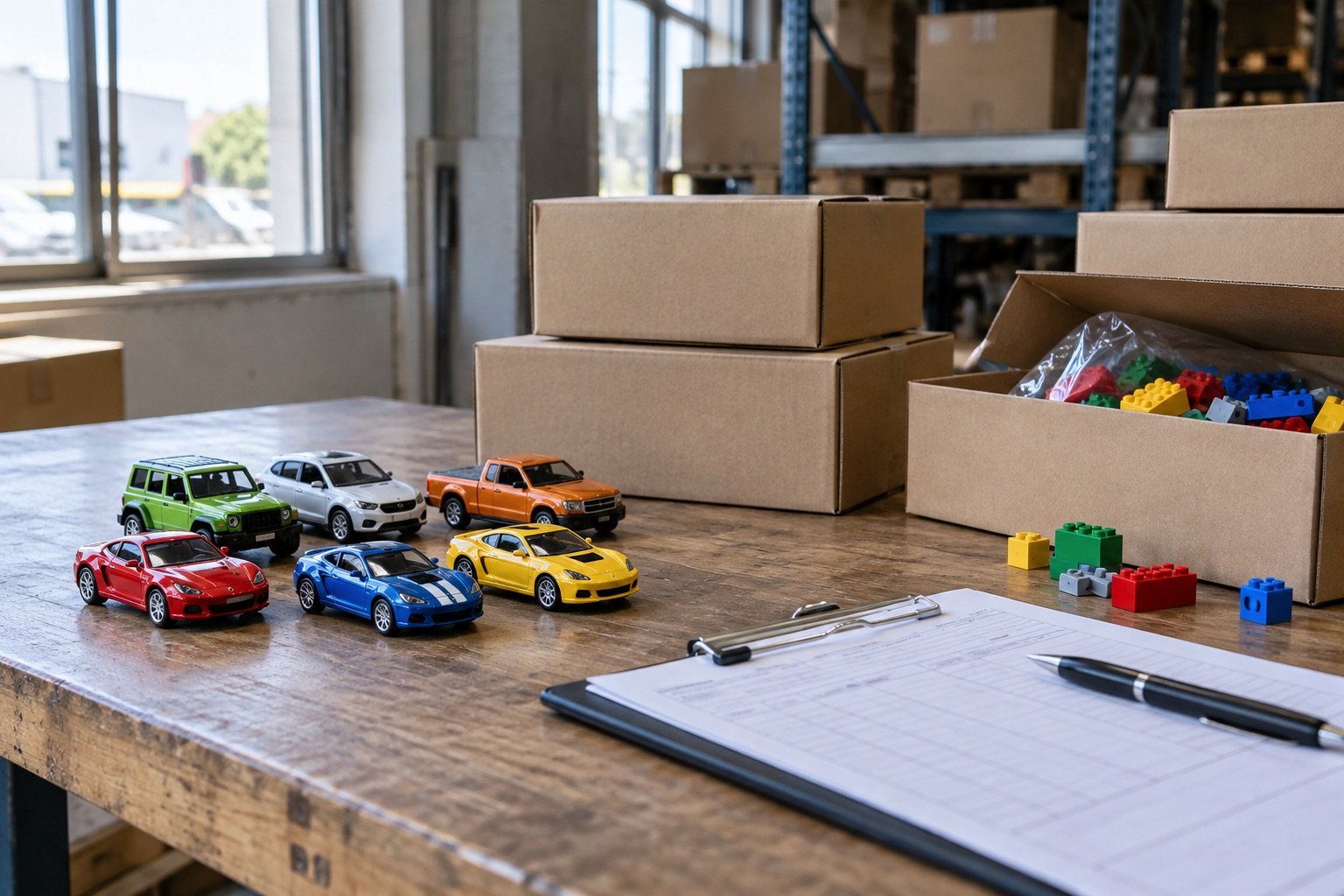
A useful wholesale toy manifest identifies each toy, the number of sellable sets or units, packaging condition and relevant model or product identifiers. Before ordering, match that information to the age labels, completeness checks and sales channel requirements for the stock. A large piece count does not necessarily mean a large number of complete retail products.
This guide focuses on reading toy inventory for US retail and resale. For the wider purchasing process, see the Atlas wholesale toy buying guide.
Separate toys, sets, pieces and cartons
Construction toys create an easy counting mistake: the pieces inside one box are not separate retail sets. A lot of 48 boxed construction sets should be counted as 48 sets unless the listing says otherwise. Likewise, a carton of loose miniature cars may not include individual retail packaging.
Ask the supplier to define the counting unit. Record the number of cartons, products per carton and total sale-ready units. For assorted stock, ask whether the manifest lists exact models or describes a general mix.
Read the manifest at product level
- Identity: brand, product name, model and UPC or other identifiers where available.
- Quantity: complete sets or units, with case-pack information.
- Assortment: exact variants, colors and duplicate quantities, if known.
- Condition: the description for the actual lot, including packaging damage or missing parts.
- Completeness: instructions, accessories and components required for the product.
- Documentation: relevant supplier records and information your selling channel requests.
Use the Atlas manifest guide to organize the figures. If an important field is unavailable, mark it as unknown rather than filling the gap from a stock photograph or a similar online listing.
Compare construction sets with pull-back cars
Atlas lists a wholesale lot of 48 GI Joe construction sets and a lot of 8,000 pull-back die-cast toy cars. These offer very different inventory workloads. Construction sets need checks for complete packaging and the correct included components. A large car assortment needs a plan for counting, display and individual or bundle packaging.
Ask whether each car is loose, individually bagged or retail packaged, and whether colors are specified or assorted. Confirm age markings from the actual packaging. Do not advertise a toy as suitable for toddlers because it is small or inexpensive. Catalog listings are examples; current stock, assortment and order terms need confirmation.
Check age labels and recalls using exact identifiers
Keep manufacturer age recommendations and warnings visible when presenting the product. An age label is product information, not a guarantee that the item suits every child. Avoid changing or inventing age recommendations when you prepare listings or bundles.
Search the CPSC recall database using the product name and available model identifiers. The CPSC online seller guidance says resellers should check stock for safety and recalls. A database search is one part of review, not a certification that every aspect of a toy complies.
Understand who provides product documentation
A Children’s Product Certificate, or CPC, is issued by a manufacturer or importer, not an approval you obtain from CPSC. The agency’s seller FAQs explain that resellers generally do not issue a CPC, while marketplaces can set additional documentation requirements. Ask your supplier and check your intended selling channel before committing to stock.
Your obligations can change if you import, manufacture or materially alter products. Seek qualified product-compliance advice when your role or the requirements are unclear. Do not describe a toy as “CPSC approved”; the agency does not provide premarket product approvals.
Count labor and packaging in the resale plan
Imagine a hypothetical purchase of 1,000 loose cars costing $500 delivered. Display and packaging materials cost another $100. If your inspection identifies 950 units suitable for sale, the allocated cost is about $0.63 per unit, before labor, fees and customer delivery.
If you plan packs of five, 950 cars make at most 190 complete packs, assuming the assortment supports your pack design. Price the pack with its packaging and preparation time included. This example illustrates counting and cost allocation; it is not an Atlas offer or a sales forecast.
Prepare a receiving checklist
- Photograph the shipment and carton labels.
- Reconcile quantities against the agreed manifest.
- Separate incomplete, damaged or uncertain products.
- Retain product identifiers and relevant documentation.
- Confirm recall checks and channel requirements before listing.
- Submit discrepancies through the agreed claims process.
Related toy lots in the Atlas catalog
Compare these advertised lots by complete units, packaging and preparation needs. Confirm current availability, variants and condition rather than treating the catalog title as a complete manifest.
- GI Joe construction sets: 48-set lot. Ask for the exact boxed set, original age markings and whether the supplied sets are complete.
- Pull-back die-cast toy cars: 8,000-car lot. Confirm whether the cars are loose or individually packaged, whether the colors are specified, and how the count is established.
- Remote-control toy cars: 312-unit lot. Request information about controllers, batteries or chargers, packaging and functional checks for the exact models.
Choose the sales format before placing the order
A boxed construction set may be ready for an individual product listing once condition and documentation are resolved. Loose toy cars may require a display tray or clearly described multipack. Remote-control toys can need more inspection time because several components must work together.
Decide whether you will sell individual units, fixed packs or retailer quantities. Describe the count and assortment clearly. If colors vary, explain how they are selected instead of showing one combination and implying that every buyer receives it.
Keep original warnings and product identifiers with the items. Repackaging or creating new bundles can raise questions about labels and your responsibilities. Review the requirements for the actual product and seek qualified advice if you are changing how it is supplied.
Inspect completeness without confusing it with compliance
A complete toy is one that includes the components needed for the particular product. That check can identify a missing controller or instruction sheet. It does not by itself prove that the toy meets every applicable safety requirement.
For sealed construction sets, ask how completeness was established without claiming that every sealed box was opened and counted. If the supplier inspected a sample, keep the sample scope in your records. Separate packaging damage from missing components in the receiving report.
For remote-control toys, use the manufacturer’s instructions for the model and record whether the controller and toy were tested together. Do not substitute a similar charger or battery simply because it fits. Unresolved power or battery concerns need suitable expertise.
Keep an identifiable record of your stock
Store supplier invoices, carton photographs, model information and available product documents in one record. Link that record to the stock location and the listings created from it. A clear record is useful if a marketplace asks about the product or you need to investigate a discrepancy.
When multiple variants arrive, keep them distinguishable through receiving and packing. Avoid discarding all labels as soon as cartons are opened. Product identity matters for recall checks, customer questions and matching the shipment to the agreed manifest.
Do not infer licensing from a familiar character printed on a package. For branded or character merchandise, ask about sourcing and the documents your platform requires. A recognizable name is not evidence of an authorized business relationship.
Frequently asked questions about wholesale toy manifests
Does a 48-set construction lot contain only 48 construction pieces?
No. The wholesale set count and the number of pieces inside each set are different. Confirm the exact boxed product and its contents rather than multiplying or dividing numbers without defining the unit.
Can I assume loose toy cars come in retail packaging?
No. Ask whether units are boxed, bagged or loose. Packaging affects display, preparation cost and what you can accurately show in your customer-facing photographs.
Are small toys suitable for toddlers?
Size and price do not establish an appropriate age. Use the original manufacturer age recommendations and warnings for the actual product. Do not invent a younger age range to broaden the audience.
Can I choose exact colors or models from an assorted toy lot?
Only if the supplier confirms that option. An assorted lot may have a fixed mix. Request the actual variant counts and order terms before promising a specific assortment to your customers.
Does a CPC mean a toy is approved by CPSC?
No. A Children’s Product Certificate is issued by the manufacturer or importer. CPSC does not provide premarket product approval. The documentation you need also depends on your role and selling channel.
What if the delivered count differs from the manifest?
Document the count, retain carton identifiers and photographs, and follow the agreed claims procedure promptly. Ask before ordering whether the manifest is exact or estimated and how discrepancies are handled.
Choose a lot with a clear purchasing plan
Browse Atlas toys and baby inventory with a clear plan for counting and presentation. Contact Atlas Wholesale Group in Dallas, Texas, USA at admin@atlaswholesalegroup.com or +1 (214) 236-7711 with the product link, your intended sales channel and the manifest details you need.