
Wholesale Electronics Listings: Clear Product Details
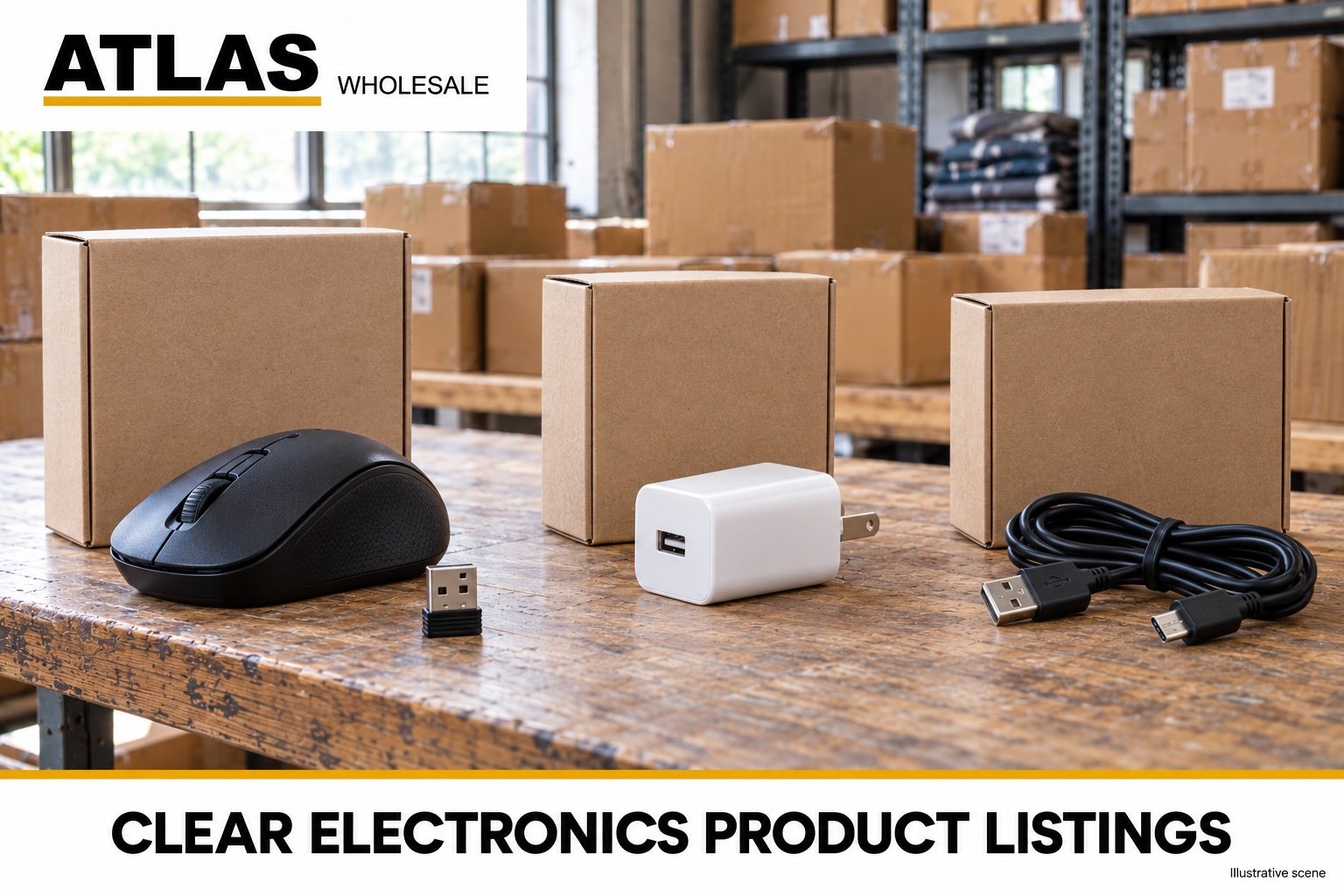
A useful wholesale electronics listing identifies the exact product, included components, verified compatibility and the condition the customer will receive. Start with a model record rather than copying every phrase from a supplier title. Clear descriptions can reduce avoidable questions, although they cannot guarantee sales or eliminate returns.
This guide covers product listing preparation for resellers of computer accessories and small electronics. Use it after the electronics testing workflow and the accessories buying checklist. A customer-facing listing should reflect the checks and documentation available for that specific stock.
Build one source record for each model
Keep the model number, product name, connector type, power requirements and included parts together. Attach reliable manufacturer information where available, and distinguish it from a supplier estimate or your own test observation. If two similar boxes contain different models, create separate records before creating public listings.
Use an internal SKU that stays with the product through receiving, photography, storage and dispatch. A broad shelf label such as mouse stock is not enough when one variant includes a receiver and another does not. The source record should tell the next employee exactly which group supports the offer.
Leave an unknown specification unresolved instead of borrowing it from a similar-looking product online. A product can share a housing design with another model while having different features. If the missing information materially affects use, obtain confirmation before offering the unit as suitable for that purpose.
State included components before optional benefits
For a wireless mouse, say whether a receiver is included and what connection method the model supports. For a charger, identify the actual connector and whether a cable is supplied. For a flashlight, confirm the documented power source and any included accessories. Do not infer contents from a promotional image.
Separate included items from items required for use. If batteries or a compatible host device are not included, make that clear. A photograph of a laptop beside a mouse can help show context, but it must not suggest that the laptop forms part of the offer.
Keep the completeness statement consistent across title, images and description. A bullet saying cable not included cannot reliably correct a hero photograph dominated by a cable and language implying a complete charging kit. Review the overall message rather than checking individual sentences in isolation.
Describe compatibility at the right level
Compatibility should identify a supported interface, device type or documented model relationship, not simply say universal. A Micro USB connector is different from USB-C, and physical fit does not establish every electrical or software requirement. Use evidence for the exact product and application.
For a mouse, distinguish a basic function check on one operating system from a claim about all computers or gaming performance. If manufacturer documentation lists supported systems, preserve that information accurately and do not extend it to systems you have not verified.
For a power accessory, unresolved rating or safety questions need appropriate review before sale. Do not use a listing-writing exercise to improvise electrical testing or certify an item. Hold questionable or damaged units separately while the underlying product issue is resolved.
Write the title for identification, not a wall of claims
A concise title can follow product type, model, key connector or connection method, quantity and condition. Choose the fields that help the customer distinguish the item. Long strings of keywords and unrelated device names make it harder to see what is actually being sold.
Do not include a brand merely because it may attract searches. A supplier reference to a brand must describe the actual goods and does not automatically prove authorization or authenticity. Request sourcing evidence when needed and follow your marketplace requirements.
Keep detailed packaging notes and test scope in the description, where they can be explained. The title should not claim new when the stock is returned or opened. If condition varies, separate offers or clearly define the variation rather than using the most attractive condition for the entire group.
Related Atlas product listings
These are catalog examples checked on October 26, 2026. A published listing does not guarantee current availability, an exact assortment or marketplace eligibility. Confirm the final quotation and product records before ordering.
- Wholesale Lot Of 5,846 Wireless Gaming Mouses – Model: D-09 – Your Price Is Only $1.50 Each. Use the D-09 identifier and confirm the receiver and connection details before writing the offer.
- Wholesale Lot Of 1,636 Verizon Wall Charger – Micro USB – Fast Charge – 3 AMP UPC 097738603481 – MSRP $34.99 Each – Your Price Is Only $1.50 Each. Preserve the Micro USB distinction and verify product specifications rather than promising compatibility with every phone.
- Wholesale Lot Of 4,629 High Lumens LED Flashlights – MSRP $27.99 Each – Your Price Is Only $5.00 Each. Request model and power-source information; avoid performance claims based only on a promotional description.
Use product photographs that answer practical questions
Prepare a front view, connector or receiver view, model label and included-parts photograph. Show packaging condition where it affects the offer. Use consistent lighting and enough detail to distinguish similar connectors without forcing customers to guess from a distant image.
Keep serial or internal tracking records securely where required; public photos should focus on information useful to the buyer. Do not alter labels to improve an image or remove a visible defect that matters to condition. A clean background is helpful, but it should not change the product being represented.
If you use an illustrative banner for a buying guide, label it as illustrative and keep it separate from the product evidence. A styled image of generic accessories does not prove the exact model, packaging or quantity available in a specific lot.
Explain testing without overstating it
A test statement is most useful when it names the checks performed. Cursor, clicks and scrolling checked on a named test environment is clearer than a broad perfect condition claim. Record the scope internally, then summarize it accurately for the customer.
Do not convert a brief power-on check into a statement about long-term reliability, battery life or certification. Those are different questions. If a product was not tested, disclose that status where relevant rather than creating an impression that all functions were verified.
The FTC advertising guide explains that advertising claims need an adequate basis. Retain the evidence behind important statements and review model-specific safety or recall questions through appropriate sources. This is general listing guidance, not a legal compliance determination.
Plan price and quantity around the actual sales unit
Decide whether the offer is one unit, a retail pack or a bulk group. A customer should not have to interpret a wholesale carton photo to understand the quantity. Use the same unit in stock records, order confirmation and packing instructions.
For a hypothetical ten-unit pack, assume $20 acquisition cost, $4 inbound freight allocation and $6 preparation and packaging. The cost before fees and customer delivery is $30, or $3 per unit. If you list the pack for $45, the $15 difference is not net profit. The figures illustrate a method and are not an Atlas quote.
Compare whether a pack format suits the buyer. A small retailer may value a quantity that matches shelf space, while an individual customer usually needs a clearly defined single item. Avoid imposing a large bundle merely because the original wholesale lot is large.
Keep listing changes connected to inventory
When stock changes, review the description, pictures and available quantity together. A replacement shipment with different packaging should not automatically inherit the old condition statement. Keep a dated model record for the batch supporting the active offer.
Create a short final review: correct model, count, included components, supported compatibility, actual condition and accurate photos. Have the packing process check those same fields. This connects the promise on the page with the item leaving the shelf.
Track customer questions after publication. Repeated requests about a receiver or connector are a signal to improve the listing, not evidence that the product needs more promotional adjectives. Link to the applicable claims information where relevant to the wholesale purchase, while setting your own retail terms consistently with your obligations.
Frequently asked questions
Can I call an accessory universal?
Only when that scope is supported. Exact connector and compatibility information is usually more useful than an unsupported universal claim.
Should a product title include every compatible device?
Include only verified, relevant identifiers. Put necessary detail in a readable compatibility section rather than an unstructured keyword list.
Does powered on mean fully tested?
No. Describe the functions actually checked and do not imply broader testing or certification.
Can I use one photograph for different models?
Only if it accurately represents the offered item and any variation is clear. Separate images are safer when visible details or included parts differ.
What should I do when a specification is missing?
Ask for reliable model-specific information. Do not fill the gap from a similar product or promise a function that remains unverified.
Plan your next purchase
Browse Atlas electronics inventory and send Atlas the product link with the product model, required components, target selling format and delivery ZIP code. Atlas Wholesale Group is based in Dallas, Texas, USA. Email admin@atlaswholesalegroup.com or call/WhatsApp +1 (214) 236-7711. Ask for written confirmation of availability, condition, quantities and delivery charges before placing an order.