
Wholesale Towels and Blankets: What Buyers Should Check
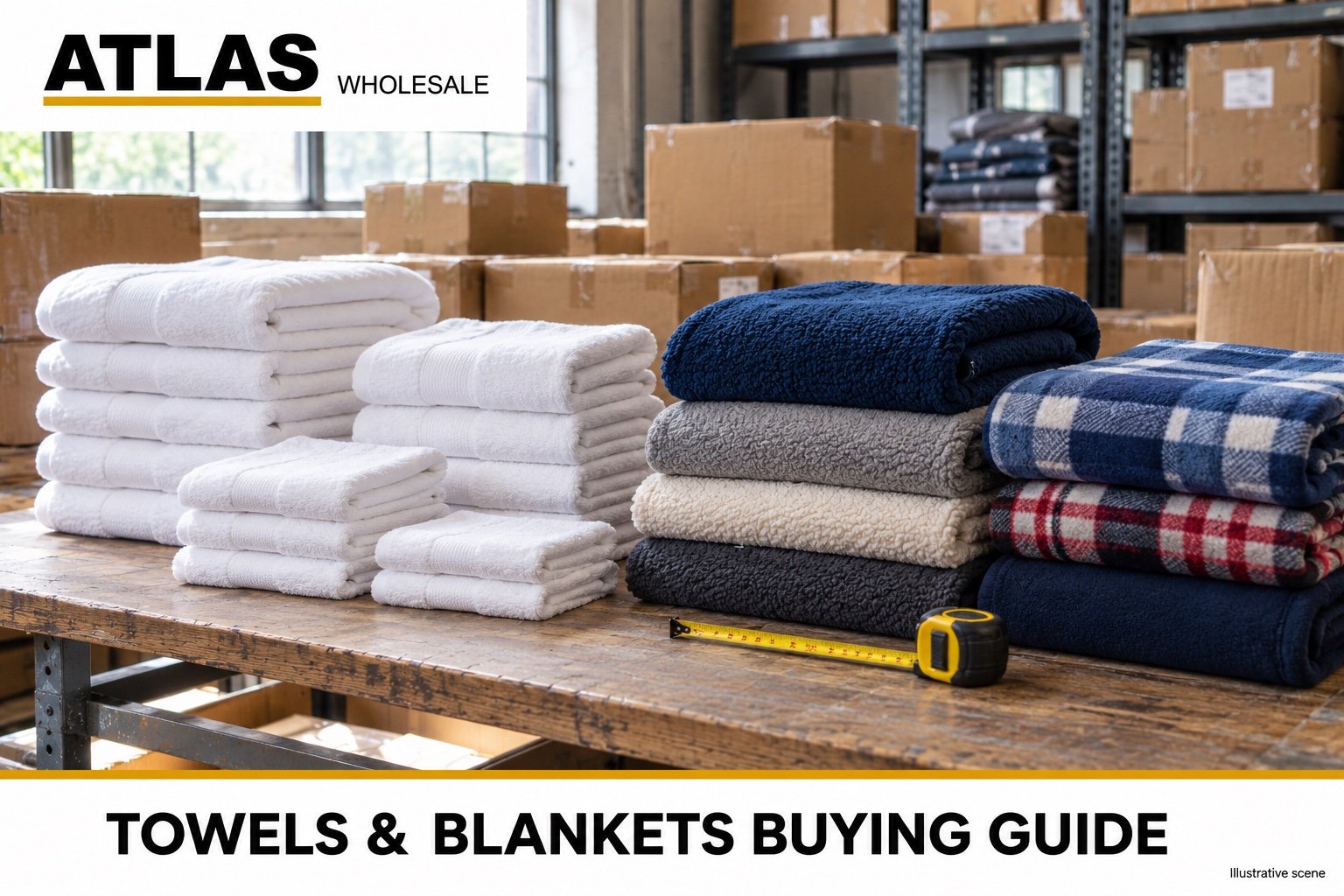
Compare wholesale towels and blankets by confirmed dimensions, materials, condition, packing unit and delivered cost per sellable item. Case count alone does not tell you the size or weight of a towel, and a soft-looking blanket photograph does not establish its fiber content or suitability for a particular use.
This guide helps US home goods resellers turn a short product description into a usable specification checklist. It complements the housewares delivered cost guide with closer attention to towel and throw blanket details. It does not assign unverified grades or promise that one specification is best for every customer.
Start with the customer and intended use
A shop selling economical household towels has different needs from a buyer filling an institutional supply contract. Clarify your customer, expected product size, price position and required documentation before comparing lots. Do not describe an ordinary household listing as suitable for a specialized use without evidence.
For blankets, establish whether your customers want a decorative throw, a lightweight layer or another specific format. The terms throw and blanket can be used loosely in listings, so use actual measurements. A familiar product name should not replace dimensions, materials and care information in your own customer description.
List any non-negotiable requirements first. If a customer requires a particular fiber, measurement or performance record, leave that field unresolved until the supplier confirms it. Do not turn an estimate based on photographs into a binding promise in your own sales quotation.
Convert case counts into individual pieces
Distinguish cases, packs, pairs and individual units. Ask how many pieces are in each case and whether the quoted price is per case or per piece. Record the total on a worksheet and confirm that the invoice uses the same unit. Confusing a case price with a piece price can make an otherwise simple comparison misleading.
The Atlas economy bath towel listing describes 22 cases, 96 towels per case, for 2,112 towels. That is a packaging statement from the listing, not a physical count performed for this article. Ask for current packing confirmation and whether partial quantities are available before planning a smaller resale order.
Keep your internal stock unit consistent. If you receive by case but sell individually, convert the receipt into individual units after counting. Retain the case reference for any discrepancy so the supplier can identify which carton is affected.
Request dimensions, fiber and weight information
Ask for towel width and length, fiber composition, construction and care instructions. If a supplier quotes GSM, ask what material and measurement it refers to; GSM means grams per square meter and describes mass per area. It does not, by itself, establish absorbency, durability or overall quality.
For a throw blanket, record finished dimensions, fiber composition, edge construction and packaging. A stated 50 by 60 inch size is a dimension, not a guarantee that every item has been measured to an exact tolerance. Ask about permissible variation where size consistency matters to your customer.
Do not infer cotton content from a white color or fleece composition from softness. Use reliable product information. If important details are absent, request labels or specification photographs, and make the uncertainty visible in your purchasing decision instead of filling the gap with marketing language.
Understand what a sample can and cannot show
A representative sample can help you examine texture, seams, dimensions and packaging. Establish whether it comes from the offered stock and whether it represents the whole assortment. A premium sample selected from a different batch does not answer questions about the advertised lot.
If you evaluate laundering behavior, follow the existing care instructions and keep that sample out of unopened stock. Record the procedure and observations without turning a small informal check into an unsupported performance guarantee. A single towel cannot establish the behavior of every item in a mixed shipment.
Use samples to identify questions as well as preferences. If the towel size differs from your expectation or a blanket label conflicts with the listing, resolve the discrepancy before ordering. Keep photographs and the written clarification with your purchase record.
Review labels and retail descriptions
The FTC textile labeling guide explains information requirements for covered textile products. Review the applicable guidance for the specific goods and your role, particularly when importing or relabeling. Do not replace a missing fiber declaration with a guess or obscure existing product information.
Avoid unsupported phrases such as hotel grade, hypoallergenic or guaranteed shrink-proof. If a customer requests a special standard, ask for relevant documentation for the exact item. A warehouse inspection and a soft hand feel do not establish those claims.
Related Atlas product listings
These are catalog examples checked on October 20, 2026. A published listing does not guarantee current availability, an exact assortment or marketplace eligibility. Confirm the final quotation and product records before ordering.
- Wholesale Lot Of 22 Cases Brand New Economy White Bath Towels – 2,112 Units (96 Per Case) – Only $88.00 Per Case. Confirm bath towel dimensions, fiber information and the 96-piece case pack.
- Wholesale Lot Of 576 Imperial Home 50×60 Soft Fleece Throw Blankets – MSRP $30 – Your Price Is Only $4.00 Each. Confirm the listed 50 by 60 inch dimensions, assortment and material information.
- Wholesale Lot Of 120 ELLE Precision Digital Bathroom Scales – UPC 681066020173 – MSRP $29.99 – Your Price Is Only $6.00 Each. A related home goods comparison: confirm model details, packaging and included components rather than comparing all housewares by unit price alone.
Budget for space, receiving and delivery
Textiles can occupy substantial space even when their individual weight is modest. Request case dimensions, gross weight, pallet count and the expected delivery arrangement. Confirm whether your location can receive the shipment and whether extra services are needed. Review Atlas shipping information before accepting a freight quotation.
Do not assume that a product title mentioning shipping covers every destination or service. Ask for the actual delivery terms in the written quote. Residential delivery, access restrictions and handling requirements can affect the total even when the merchandise itself is straightforward.
Plan a dry, clean storage area before arrival. Keep product labels and carton identifiers readable, separate inspected stock from holds, and avoid placing new textiles directly on a dirty receiving floor. Receiving organization protects the presentation customers expect and makes later count checks easier.
Calculate cost using your actual selling format
Suppose a hypothetical 96-piece case costs $96, its allocated delivery cost is $24 and preparation adds $12. The total is $132, or about $1.38 per piece if all 96 are suitable for the intended channel. If only 90 are sellable there, the allocated cost becomes about $1.47. These are illustrative numbers, not Atlas prices or a defect forecast.
If you sell sets of four, calculate the cost per complete set and account for remaining pieces. Add packaging, selling fees and customer delivery separately. A bundle discount should come from a workable calculation rather than simply multiplying an original retail value.
Track actual time spent counting, sorting colors, photographing and repacking. Compare that record with your plan after the first purchase. A lower merchandise price can be offset by complicated assortment handling, while a simpler case pack may reduce preparation work for your particular business.
Make a specification sheet customers can compare
Keep one short sheet per textile style with confirmed dimensions, fiber information, case pack and available care details. Mark missing fields as awaiting confirmation rather than copying a specification from a similar-looking product. Include the date and supplier reference so staff know which shipment the information describes.
When a customer asks for a different quantity or bundle size, use that sheet to calculate complete packs and delivery needs. This creates a consistent answer without inventing performance claims. Update it when the actual received goods differ, and resolve any disagreement before repeating the supplier wording in your own listing.
Frequently asked questions
Does a case price mean the price of one towel?
No. Confirm both the case price and pieces per case, then calculate the individual cost using the agreed packing information.
Does higher GSM automatically mean a better towel?
No. GSM describes mass per area. Dimensions, construction, materials and the intended use also matter.
Can I describe every fleece throw as the same material?
No. Fleece describes a fabric form, not a verified fiber percentage. Use the exact product labeling or reliable specifications.
Is a sample enough to guarantee the whole lot?
No. Confirm how representative it is and inspect the received shipment. A sample helps evaluate questions but does not establish every piece condition.
What should I report if a case count differs?
Record the carton reference, expected and actual counts and supporting photographs. Follow the supplier terms and preserve relevant packaging.
Plan your next purchase
Browse home and kitchen lots and send Atlas the product link with the required dimensions, intended selling format, case quantity and delivery ZIP code. Atlas Wholesale Group is based in Dallas, Texas, USA. Email admin@atlaswholesalegroup.com or call/WhatsApp +1 (214) 236-7711. Ask for written confirmation of availability, condition, quantities and delivery charges before placing an order.