
Wholesale Clothing Size Mix: A Buyer’s Guide
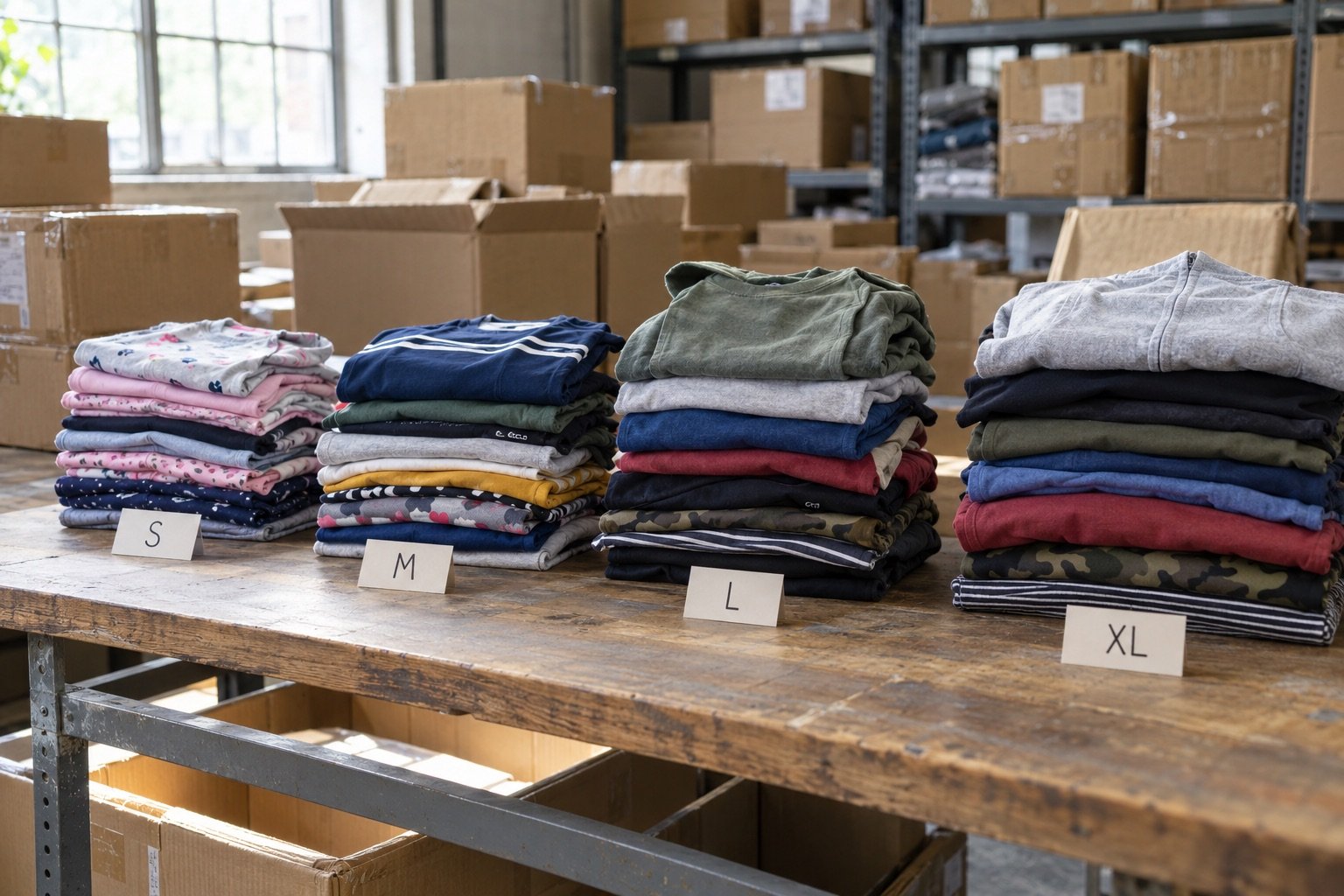
To choose a wholesale clothing size mix, compare the actual number of garments in each size with the customers you serve, then calculate the cost of the stock you expect to sell. A label such as “S–XL” gives a range. It does not tell you whether the lot contains a balanced assortment or mostly one size.
This article focuses on size planning for US clothing retailers and resellers. For a broader introduction to condition, manifests and ordering, read the Atlas wholesale clothing buying guide.
Start with your customers, not the discount
Look at your own recent orders, sold listings or store records. Which sizes sell without repeated markdowns? Which styles attract the customers who actually visit your shop? A junior clothing assortment may suit a different audience from men’s T-shirts, even when both listings use familiar size letters.
If you do not yet have sales records, keep the first purchase manageable. Research comparable garments in your intended selling channel and record the size, condition, asking price and evidence of completed sales where available. Treat this as a starting estimate rather than proof that your stock will sell at the same price.
Ask for quantities by size and style
A useful apparel manifest separates size, style, quantity and condition. Ask whether those counts are exact, estimated or unavailable. If the supplier can only confirm a size range, include that uncertainty in your buying decision.
- How many pieces are in each labeled size?
- Are the garments junior, women’s, men’s or children’s sizing?
- How many different styles and duplicate pieces are included?
- Are colors and sizes tied to specific styles?
- Are original size, fiber and care labels present?
- Does the assortment include irregular, returned or damaged garments?
The manifest reading guide can help you organize these answers. Do not assume that several photos show every style or that a photographed size represents the whole shipment.
A size range is not a size distribution
Consider a hypothetical 100-piece lot containing 60 small, 20 medium, 15 large and 5 extra-large garments. If your buyers usually want medium and large, the lot can leave you with more small pieces than you can move. The issue is the relationship between supply and your demand, not whether small garments are inherently difficult to sell.
Use a simple worksheet with four columns: size, pieces offered, your expected demand and planned selling route. Flag any size for which you do not have a credible outlet. That may mean choosing another lot, negotiating a smaller order if available, or planning a separate clearance channel before buying.
Compare actual Atlas clothing listings
The Atlas catalog includes a 1,000-piece junior clothing lot with a listed S–XL range and a 720-piece Gildan men’s T-shirt lot listed as slightly irregular in sizes S–3XL. These listings describe different audiences and conditions. A wider size range alone does not make one the better purchase.
For the junior assortment, request counts by style and size. For the Gildan assortment, ask what “slightly irregular” means for the particular garments and whether the defects affect your intended use. Product titles are a starting point; confirm the current assortment, quantity and quote before ordering. A retailer or brand name in a listing does not establish a direct supplier relationship or authorization to sell on every marketplace.
Allow for slow sizes in your cost calculation
Suppose a hypothetical lot costs $300 plus $100 in freight and preparation. If you expect to sell 80 pieces through your planned channel, the allocated cost is $400 ÷ 80, or $5 per expected sale. The remaining 20 pieces still need storage or another outlet. This is a planning example, not an Atlas price or a forecast.
Run a second scenario with fewer expected sales and more markdowns. Include selling fees, outbound shipping, packaging and labor separately. A lot that only works when every piece sells quickly at full price deserves a closer look.
Keep labeling and receiving checks in the plan
The FTC textile labeling guide explains that most covered textile products need fiber content, country of origin and responsible business identification; clothing care labels fall under a separate rule. Preserve existing labels and review the applicable guidance before relabeling garments.
On arrival, count the stock by style and size, photograph discrepancies and separate damaged pieces. Measure a representative garment from each style for your listings instead of applying one size chart to unrelated brands. Check the agreed returns and claims process before the shipment arrives.
Related clothing lots to compare
Compare these catalog examples by audience, size distribution and condition. The listed quantities describe the advertised lots; ask Atlas to confirm the stock currently available. Prices, freight and assortment should come from your final quotation.
- Junior clothing assortment: 1,000 pieces, S–XL. Useful to investigate when your customers shop junior styles. Ask for a breakdown of garments and sizes rather than assuming equal quantities.
- Gildan men’s color T-shirts: 720 pieces, S–3XL. The listing describes slightly irregular stock. Request defect examples and check whether the irregularities affect fit, presentation or your intended use.
- Team 365, Ultraclub and Econscious sports clothing: 4,683 pieces, XS–4XL. A broad range makes a size-level manifest particularly useful. Establish the brand and style quantities before planning separate product listings.
Match the assortment to your selling channel
Online single-item sales usually need photographs, measurements and condition notes for each style. A market stall may let customers compare garments in person, but you still need clear sizing and organized racks. Selling bulk bundles can reduce the number of listings, although the bundle has to make sense to the buyer.
Choose the channel before you choose the lot. If your shop sells workwear, a junior fashion assortment may not fit your existing customers. If your online store specializes in one clothing type, a mixed lot can create additional photography and catalog work. Count that workload alongside the price.
For each style, decide how many pieces you will list immediately, keep in reserve and route to a markdown section. Avoid offering bundles with unwanted sizes hidden inside them. Describe the actual contents and let buyers judge whether the assortment suits their needs.
Build a size-by-style purchasing worksheet
Start with one row for each style and size combination. Add columns for garment count, quoted unit cost, measured dimensions, intended selling price and expected preparation time. Leave an unknown count blank until the supplier confirms it. This prevents an estimated assortment from becoming an apparently precise buying plan.
Next, compare the worksheet with your own sales records. A lot containing many duplicates of a familiar style may be easier to photograph than a smaller lot containing dozens of unrelated styles. On the other hand, duplicates can tie up cash when the size mix does not match demand.
Use a separate note for assumptions such as expected markdowns or sell-through. Revisit those assumptions after receiving and selling the first stock. Your records become more useful when they distinguish what the supplier stated from what you predicted.
Questions to send before ordering
A specific inquiry is easier to answer than “Is this a good lot?” Send the product link and explain your audience. For example: “We sell junior tops online and need the size counts, number of styles, tag condition and carton dimensions for this lot. Can you confirm whether the manifest is exact?”
Also ask about the shipping origin, delivery services and the procedure for a count discrepancy. Review wholesale delivery information before comparing quotes. Do not allocate your entire budget to merchandise if you still need freight, hangers, storage containers or packaging.
Frequently asked questions about clothing size mixes
Does S–XL mean equal quantities of each size?
No. S–XL identifies a size range, not a distribution. Ask for the actual counts and whether those figures apply to every style or to the assortment as a whole.
Can I use one size chart for a mixed-brand clothing lot?
Only if it accurately describes the garments. Junior and adult sizing can differ, and fit varies by style. Use manufacturer information where available and provide relevant garment measurements for the specific items you list.
Are irregular T-shirts the same as customer returns?
No. Irregularity and return status describe different aspects of stock. Ask why the garments are irregular and whether they are unused, returned or mixed condition. Do not substitute one description for another.
Should a new reseller buy the biggest clothing lot?
Size alone is not a reason to buy. Choose a quantity you can inspect, store and list with your available cash and time. A smaller suitable assortment may offer a more manageable first purchasing test.
How should I handle sizes that sell slowly?
Plan their route before ordering: a separate channel, a clearly described bundle or a realistic markdown. Track actual sales, and do not count unsold garments as revenue merely because they have a retail value on the manifest.
Choose an assortment you can explain and sell
A workable size mix connects the manifest to your customer base, storage space and selling plan. Browse Atlas clothing and apparel lots, then ask for the size breakdown and condition details that matter to your business. Contact Atlas Wholesale Group in Dallas, Texas, USA at admin@atlaswholesalegroup.com or call/WhatsApp +1 (214) 236-7711 with your target sizes, quantity and delivery ZIP code.